
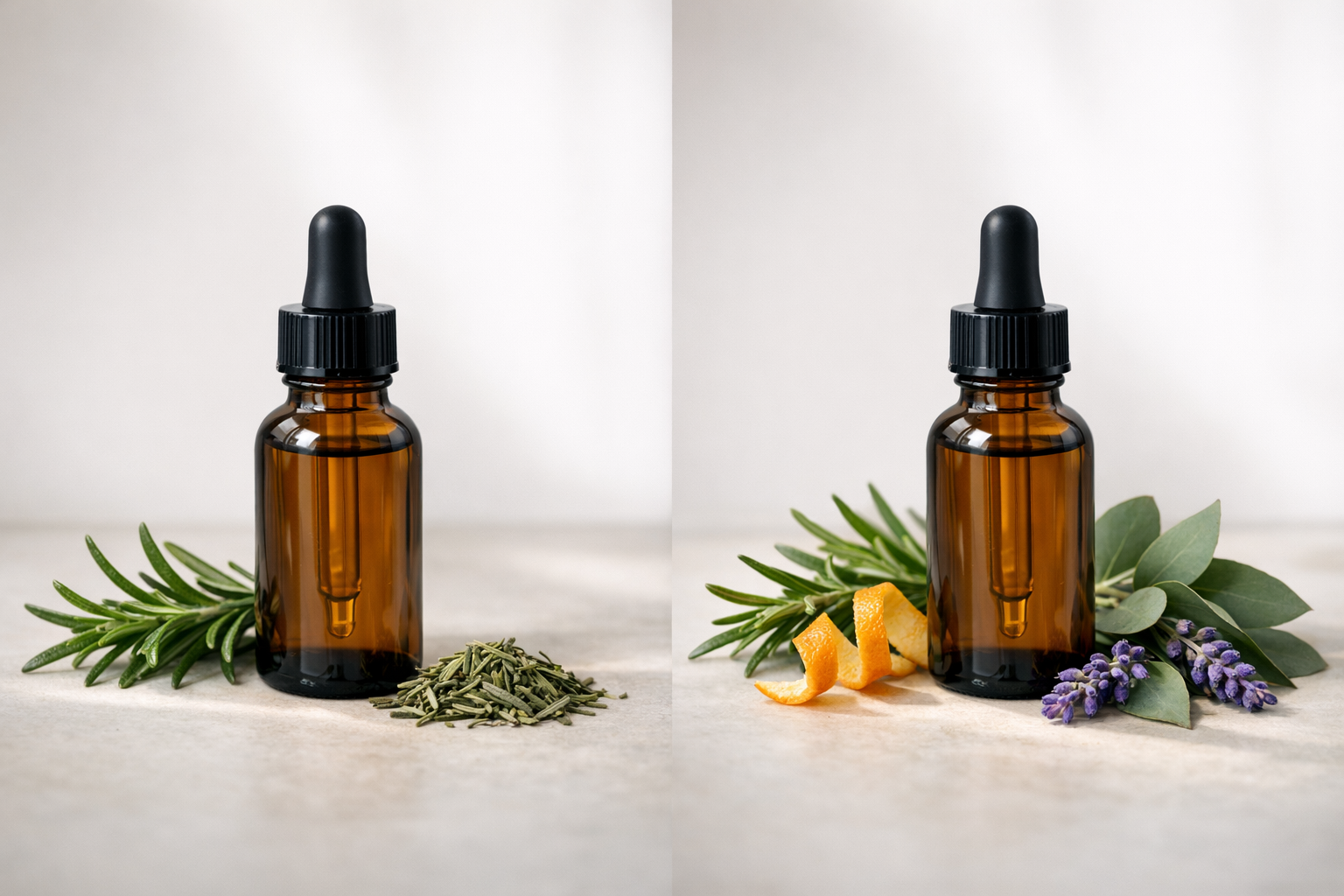
Rosemary Oil can feel simple at first. You search for a bottle, see a few options, and assume they all do roughly the same thing.
Then the labels start to get confusing.
Pure Rosemary Essential Oil. Organic Rosemary Essential Oil. Natural Blend Rosemary Oil. French Rosemary Essential Oil. Spanish Rosemary Essential Oil. Different origins. Different prices. Different wording. Suddenly, choosing one bottle becomes harder than expected.
The good news? You do not need to be an aromatherapist to make a sensible choice. You just need to understand what “pure” and “natural blend” usually mean, how Rosemary Oil is used, and which option suits your purpose best.
Table Of Contents
- What Is Rosemary Essential Oil?
- What Does “Pure” Rosemary Oil Mean?
- What Is A Natural Blend Rosemary Oil?
- Pure Vs Natural Blend Rosemary Oil: Quick Comparison
- When Should You Choose Pure Rosemary Oil?
- When Does A Natural Blend Make More Sense?
- How To Use Rosemary Oil Safely
- What Should You Check Before Buying?
- Making The Right Choice For Your Needs
What Is Rosemary Essential Oil?
Rosemary Essential Oil is a concentrated aromatic oil commonly steam distilled from the leaves and flowering tops of the rosemary plant, also known botanically as Salvia rosmarinus or Rosmarinus officinalis. It is known for its fresh, herbal, camphoraceous aroma and is often used in aromatherapy, massage blends, hair care formulations and natural cleaning products.
One reason Rosemary Oil is so interesting is that its composition can vary. Research has found that Rosemary Essential Oil commonly contains naturally occurring compounds such as 1,8-cineole, α-pinene, camphor, borneol and verbenone, although the exact profile can shift depending on growing region, plant variety and production conditions.
That is why two bottles labelled “Rosemary Essential Oil” may not smell identical or feel suited to the same use.
What Does “Pure” Rosemary Oil Mean?
A pure Rosemary Essential Oil is usually a single essential oil, not blended with other essential oils, carrier oils or synthetic fragrance ingredients. In simple terms, the bottle should contain Rosemary Essential Oil and nothing else.
For people who want a more traditional aromatherapy ingredient, a pure option is often the preferred choice. It allows more control when creating your own blends, especially for massage oils, diffuser blends, scalp oils or DIY body care products.
For example, someone making a personalised aromatherapy blend may choose Organic Rosemary Essential Oil when they want a single-ingredient Rosemary Oil with an organic certification focus. This can be useful when the ingredient itself matters as much as the aroma.
Pure Rosemary Oil may be a better fit when you want:
- A single botanical ingredient.
- More control over dilution and blending.
- A stronger, more distinct rosemary aroma.
- An oil for use in DIY formulations.
- A product that can be compared more clearly by origin, chemotype or certification.
What Is A Natural Blend Rosemary Oil?
A natural blend is different from a pure essential oil. Rather than being one single essential oil, it is typically made by combining natural aromatic components, essential oils or isolates to create a consistent aroma profile.
This does not automatically make it “bad” or “lower quality”. It simply means it serves a different purpose.
A natural blend may be designed to smell like a particular type of Rosemary Essential Oil while offering a more accessible price point or a more consistent scent between batches. That can be helpful for candles, soaps, room sprays, diffusers or general aromatic use where consistency and affordability matter.
For instance, French Rosemary Essential Oil (Natural Blend) may suit someone who wants the bright, herbaceous scent profile of rosemary for aromatic creations, without necessarily needing a single-origin pure essential oil.
Natural blends are often useful when you want:
- A consistent aroma.
- A budget-friendly option.
- A rosemary-style scent for home fragrance.
- An oil for soaps, candles or diffuser blends.
- Less concern about single-origin botanical purity.
Pure Vs Natural Blend Rosemary Oil: Quick Comparison
| Feature | Pure Rosemary Essential Oil | Natural Blend Rosemary Oil |
| Composition | One essential oil from rosemary plant material | A blend of natural aromatic ingredients designed to create a rosemary-style profile |
| Best for | Aromatherapy blending, DIY body care, scalp oils, massage blends and ingredient-focused use | Home fragrance, candles, soaps, diffusers and scent-focused projects |
| Aroma | Can vary depending on origin, harvest and chemistry | Usually more consistent between batches |
| Price | Often higher, especially if organic or speciality sourced | Often more affordable |
| Flexibility | High control for blending and dilution | Easy to use when scent consistency matters |
| Buyer priority | Purity, source, certification and composition | Aroma, consistency and value |
When Should You Choose Pure Rosemary Oil?
Pure Rosemary Oil is usually the better choice when the oil’s botanical source and composition matter to you.
This may include uses such as:
- Creating a diluted scalp massage oil.
- Blending with carrier oils for body massage.
- Adding to carefully formulated skincare or haircare products.
- Using in aromatherapy blends where you want a clear rosemary note.
- Choosing organic ingredients for personal care formulations.
Pure Rosemary Essential Oil is also a good choice if you like comparing details such as country of origin, botanical name, extraction method and certification. These details help you understand exactly what you are buying.
This matters because Rosemary Oil is not a one-note ingredient. Some types are fresher and more cineole-rich, while others may smell softer, greener or more camphoraceous. Studies show rosemary oil samples can vary widely in their major components, including 1,8-cineole, camphor and α-pinene.
When Does A Natural Blend Make More Sense?
A natural blend makes sense when your main goal is aroma rather than botanical purity.
Think of it like buying vanilla. Sometimes you want a whole vanilla bean for a recipe where flavour quality is central. Other times, a natural vanilla-style extract works perfectly well in a larger batch where consistency matters.
The same logic can apply to Rosemary Oil.
A natural blend may be the practical option if you are:
- Making candles or wax melts.
- Creating room sprays.
- Scenting cleaning products.
- Testing scent combinations.
- Working to a budget.
- Looking for a consistent rosemary-style aroma across repeated batches.
It is also useful for beginners who want to explore rosemary’s scent before investing in a more specialised pure or organic essential oil.
How To Use Rosemary Oil Safely
Rosemary Oil is concentrated, whether you choose a pure oil or a natural blend. “Natural” does not mean it should be used carelessly.
The Tisserand Institute notes that dilution is important because higher concentrations of essential oils can increase the risk of skin irritation or adverse skin reactions.
General safety tips include:
- Do not apply Rosemary Essential Oil directly to the skin without dilution.
- Use a suitable carrier oil for topical use, such as Jojoba Oil, Sweet Almond Oil or Fractionated Coconut Oil.
- Patch test before broader use.
- Avoid contact with eyes and mucous membranes.
- Keep essential oils away from children and pets.
- Speak with a qualified health professional if pregnant, breastfeeding, managing a medical condition or using medications.
- Do not ingest essential oils unless advised by an appropriately qualified professional.
In Australia, it is also important to be careful with therapeutic claims. The TGA states that products containing essential oils may be considered therapeutic goods if therapeutic claims are made, and those products must meet relevant regulatory requirements.
What Should You Check Before Buying?
Before choosing between pure and natural blend Rosemary Oil, look beyond the front label.
Here are the most useful things to check:
- Ingredient information: Does it say 100% pure Rosemary Essential Oil, or does it identify the product as a natural blend?
- Botanical name: For pure oils, look for Salvia rosmarinus or Rosmarinus officinalis.
- Country of origin: This can help you understand the oil’s aromatic profile.
- Extraction method: Rosemary Essential Oil is commonly steam distilled.
- Organic certification: Useful if certified organic sourcing matters to you.
- Intended use: Some products are better suited to aromatherapy, while others are better suited to fragrance projects.
- Safety guidance: A reputable supplier should provide clear usage and storage advice.
- Batch consistency: Important for makers who need repeatable scent results.
Making The Right Choice For Your Needs
So, which should you buy?
Choose Pure Rosemary Essential Oil if you want a single botanical oil, more control over blending, and a product suited to aromatherapy-style use or DIY personal care formulations.
Choose Organic Rosemary Essential Oil if you want those same qualities with the added reassurance of organic certification.
Choose Natural Blend Rosemary Oil if your main priority is aroma, consistency, affordability or use in scent-based products such as candles, soaps, room sprays or diffuser blends.
Neither option is automatically “better”. The best choice depends on what you are making, how you plan to use it, and how important purity, certification and consistency are to you.
Rosemary is a wonderfully versatile aroma, but the smartest purchase starts with the label. Read it closely, match the product to your purpose, and choose the oil that fits your project rather than assuming every Rosemary Oil is the same.